
Listener Q&A: Boundaries, Trauma, and Relationships
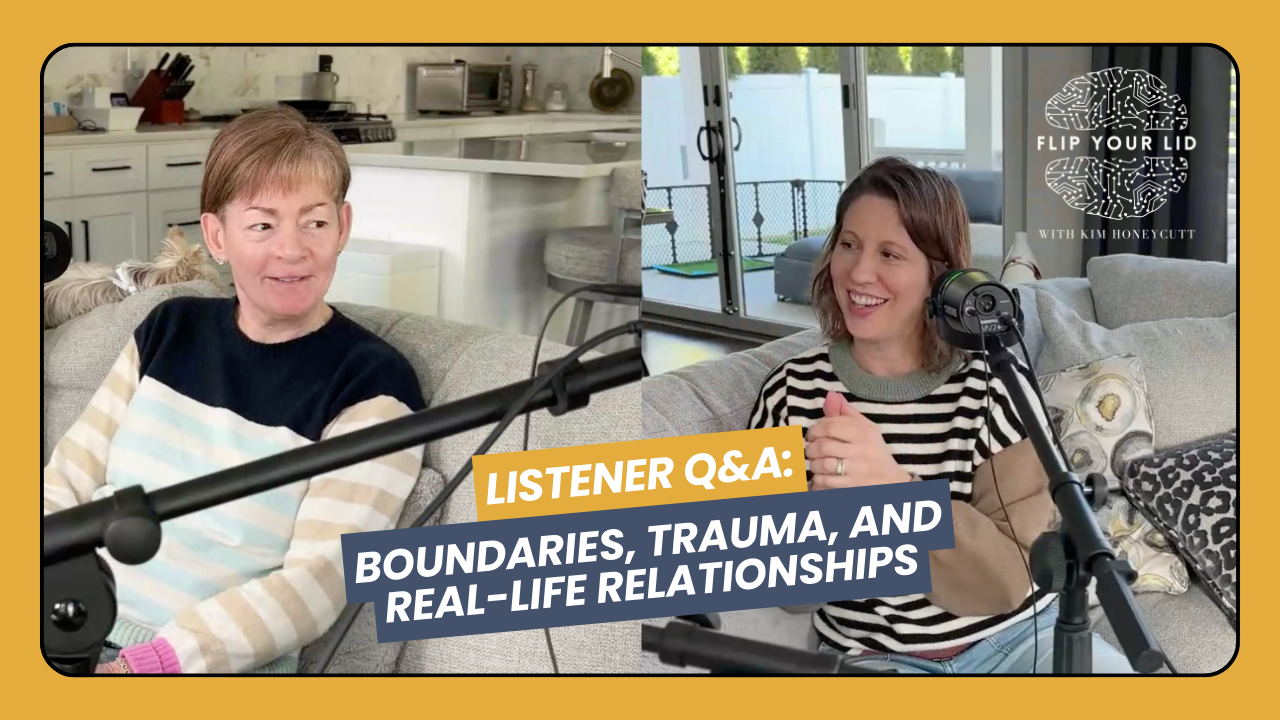
In this listener Q&A episode of Flip Your Lid, I answer questions submitted by y’all through voicemails and written messages. Larissa joins the conversation, fielding the questions and guiding the discussion.
Y’all had some great questions, and we cover topics like personal growth, identity and emotional labor, setting boundaries, supporting loved ones through trauma, attachment and connection, self-regulation, family dynamics, and tools for self-discovery like the Enneagram.
If you have a question for Kim for our next Q&A episode, call or text: 704-499-2535
Resources Mentioned in This Episode:
Dr. Stan Tatkin - Attachment patterns
Russ Hudson - Enneagram author and teacher
The Enneagram Institute - Type descriptions
The Road Back to You by Suzanne Stabile - An Enneagram Journey to Self-Discovery
Follow Flip Your Lid with Kim Honeycutt: Instagram, TikTok, Facebook and YouTube: @kbhoneycutt
This podcast is for educational purposes only and is not a replacement for individual therapy or professional mental health care.
Enjoying Flip Your Lid? Support us with a tip and keep the podcasts coming!
While you’re here, why not check out Kim’s book?

But Your Mother Loves You is the witty and candid tale of how a renowned psychotherapist moved from “not good enough” to “the right person” despite childhood neglect and a toxic relationship with her mother.
Everyone knows at least one person who demonstrates toxic love, someone who consistently jabs a straw in others and sucks the life right out of them. Without an in-depth understanding of how to navigate these relationships, most people continue to emotionally regress and remain paralyzed in familiar, pain-soaked patterns. But Your Mother Loves You helps readers overcome this cycle of toxicity.
Kim Honeycutt shares the real-life experience of how a shame-based, self-destructive little girl grew up to be a recovered alcoholic, entered the world of psychology as a professional, and created her own strategies to address and conquer toxicity.
This story, both witty and practical, is told through the lens of personal life experience and expert psychological strategies combined with Godly intervention. Readers learn how to either walk away from or walk with a toxic loved one without losing themselves. Covered in both vulnerability and clinical information, But Your Mother Loves You provides a step-by-step approach on how to stop toxic love and the subsequent self-abuse.