
Abuse Is What Happened to You. Trauma Is What Lingers. With Chuck DeGroat
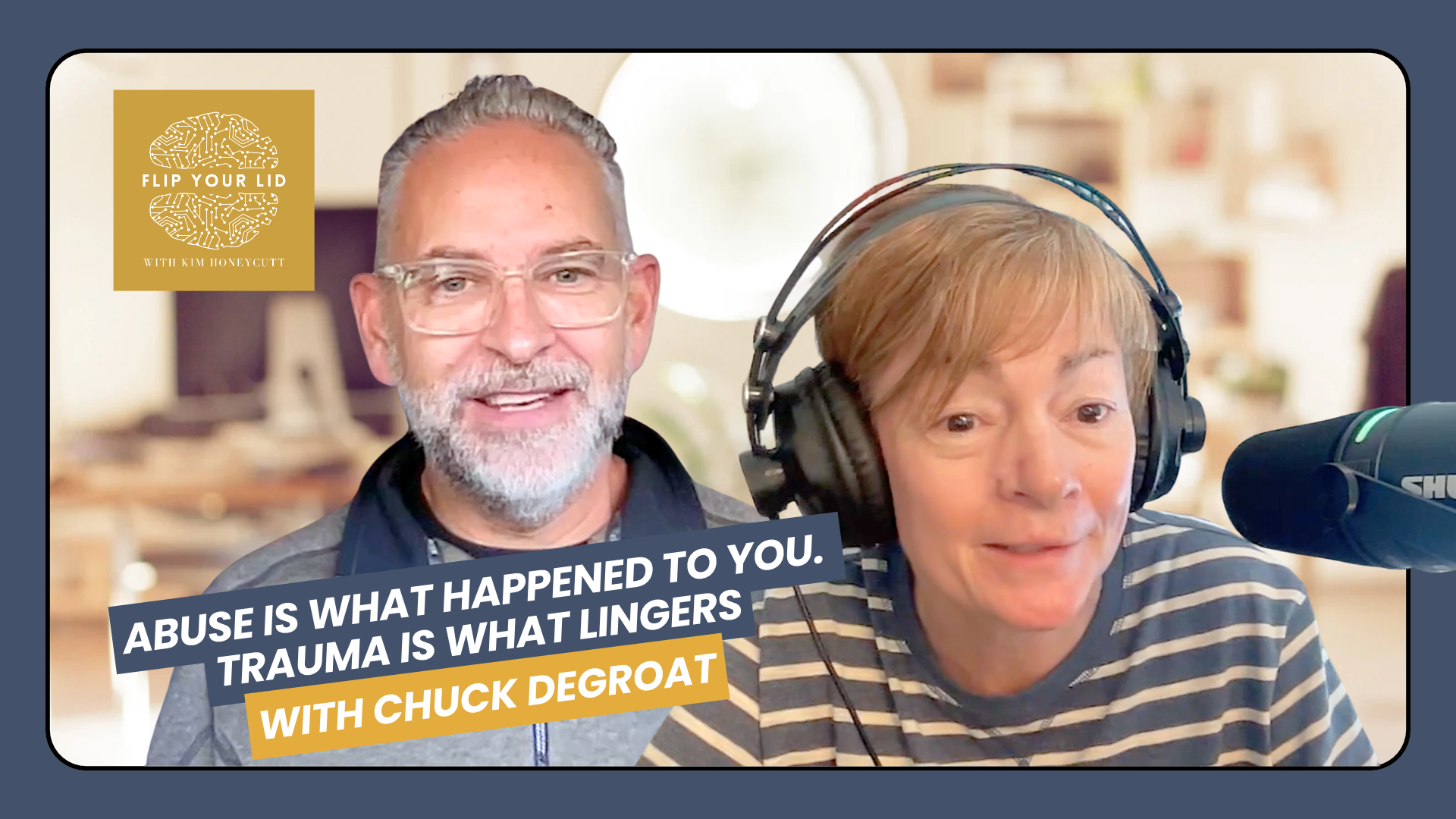
Chuck DeGroat is back after two years, with a new book and plenty to say. He and Kim cover:
Why abuse and trauma are not the same thing
The “foot on the chest” many people feel right now
Why survivors of narcissistic abuse can look unstable in family court
Why real character change takes years, “if not decades”
Saint Teresa of Avila and the practice of radical interiority
Grounding practices that build slowly over time
Hard truths, real hope. Come away with a little more trust in your own body.
Purchase Chuck's new book: Who You're Becoming: The Slow and Courageous Work of Cultivating Character in a Narcissistic Age
Connect with Chuck DeGroat: Website
This podcast is for educational purposes only and is not a replacement for individual therapy or professional mental health care.
-
Abuse Is What Happened to You. Trauma Is What Lingers. | With Chuck DeGroat
Flip Your Lid with Kim Honeycutt
Transcript
---
Kim: Hey, Chuck. Thank you for joining us.
Chuck: Yeah.
Kim: Good to see you. It's interesting, what's happened since the last time I had the privilege of spending time with you.
Chuck: Yeah, a lot.
Kim: A lot of stuff has been going on. Last time, I felt very coherent and congruent with you, but I also missed an opportunity to learn more, because it was such a meeting of the mind and spirit that I really enjoyed it. So I'm going to kick back a little more today and follow your lead. I think you have a lot of wisdom to impart, and I'm just going to be humble. I guess if you say you're humble, you're not really humble, but this is the closest I get. So I'd love for you to start wherever you'd like, talking about your book or what you're seeing within people today, and the healing within.
Chuck: Well, there's so much, as you were hinting at a moment ago. I think people are carrying not only what's going on in their own lives and stories, but what's happening more broadly in our world. In our nation in particular. Our politics and polarization and all of the pain that comes with where we currently are.
To get right to the point of why I wrote this next book, I had said I wasn't going to write any kind of follow-up to my work on narcissism. People know me for that, but I had written other books before it, and I thought, I just want to get back to my heart. People who've read this most recent one say it's very congruent with what I've written from the very beginning, and with my heart, where I want us to live in that grounded place I call home.
In this one, I was really focused on how we throw quick fixes at these big problems, including the significant problems of narcissism and abuse in the church. And how I've contributed to twenty-plus years now of conversation about health in the church, spiritual health, emotional health, when there's been this profound absence of character. Back to really basic things like love, joy, peace, patience, kindness, gentleness. We say we're a Christian nation, and we say we want pastors and leaders who are faithful and good leaders and dynamic communicators. But we've sort of forgotten that we need women and men leading us who are full of love, joy, peace, humility, maturity.
Kim: I think we need to say it now, and you're saying it so well, and it's from your heart. You're a four, right? Which can make it a little easier to be in this field, because you feel a lot. It comes from your beautiful heart. We talked about how I'm more of a doer, but I'm at a point where the feelings can't be repressed anymore. And I think you probably come across that too. It's so heavy and so deep. How are you walking through this? I know your own self-care and connection is very important to you, and that you're trying to come from that place as you help other people right now. Can you speak to that?
Chuck: I wear different hats. On any given week I may see fifteen to twenty clients, but only five to seven of those in my clinical practice. I teach, and I do some speaking and other things. I know some people see upwards of thirty.
Kim: Well, I see at least forty a week.
Chuck: Incredible, Kim. That's a lot of stories to carry in a week.
Kim: Yes, it is.
Chuck: When I got to about twenty-two, my body was like, we ought to pull back here. To be able to enter in and listen well takes our own work. I try to end every session with at least ten minutes, so I can ask myself, what just happened? Where am I right now? Maybe I dictate a note, briefly, so I don't forget anything. And yet I'm feeling the weight of this.
As I said a little while ago, there are multiple levels of what people are carrying these days. Someone came in the other day, and she had just gotten gas before our counseling session. At the time of this recording, gas prices are really high. And it wasn't just about gas. She pulled in, and her body felt the number scrolling on the pump. I asked her to stay with that for a little while. As therapists, we can take some early content that people bring in and treat it as, oh, that's just what happened today, now let's get into the meaty stuff. But sometimes the meaty stuff is actually the pumping of the gas.
Kim: You got it.
Chuck: And it just feels like there's a foot on my chest. I know her story well enough to know that the foot on her chest connects to a lot in her life, way, way back. People may not experience it the same way, but the foot on the chest is one way of naming what we're experiencing right now. Like, I don't know how to get out from under this. What she was saying is, I can't breathe. I'm having trouble catching my breath as I'm pumping gas, because as the numbers go up, I'm starting to calculate what I can afford for groceries this week. I'm thinking about how much he's giving me, and whether I'll get that check from him. I'm wondering whether my kids are safe when I send them over to him. And it just connects to a lot of different things.
Kim: Yeah. And I think that's part of why I'm so emotional, thinking about how many women I'm sitting with who have divorced narcissists. The expectations of a single mom are the same as if it's a two-parent home. They very rarely get alimony, and the child support is based on income from four years ago, ten years ago. They're $200,000 in debt, filing for custody of their kids, because they know their ex doesn't even know their kids. He doesn't know their best friend's name, doesn't care, and only shows up for image. And since 2016, the family court system has very much been mirroring the government.
It's so painful, because these women are doing everything they can. They're working on learning how to self-connect and not self-abandon, and yet everything around them is telling them they just have to survive. And the people voted for this, right? It's just painful.
Chuck: That's all part of the foot on the chest.
Kim: It's the foot on the chest.
Chuck: I can't breathe. And it seems like these days there's no way out of it. I get to the gas pump, then I have to pick up my kids from school, and I'm carrying the weight of the homework, and he's not participating in it. And the kids are wondering if daddy's going to call tonight, but he's probably not going to call. Or he'll forget to call. And I've got to think about tomorrow, and it was his responsibility to do this, this, and this, and that's not going to happen.
Kim: It's all the things. And I think part of the beauty of being a therapist is that we sit with such diverse people. We hear someone's perspective and what they're going through. They have people in their lives who haven't had the privilege I've had of meeting with a thousand different people. People take their own circumstance and put it on someone else, so they don't understand the severity of what it's like right now to be a single parent, or a sexual abuse survivor watching what's happening in this government. I think that just puts more of a need for people like you, spiritual directors and psychotherapists who are here to walk beside them.
Chuck: And I don't know about you, but I've had to give some of my clients permission to not tune in. Turn off the radio on the way to work, or whatever. Many of them have a heart for injustice, and they're tuned in to what's going on, and they want to see justice on that front. Probably not going to see it. As we know with trauma, there's a vigilance, a body that's braced. So part of it is, can you set some boundaries in places where you can control it, where your vigilance doesn't have to be on all the time? Like, today is yet another disappointment when it comes to this. You have enough of that when it comes to the court system and alimony and all of those things. But they don't want to detach from those realities either, because their hearts are big for other people. And it's beautiful.
I've heard this from clients. It's just so hard to know how to exist in this world. Some of them, even with kids, wonder, how can I do this another day?
Kim: And I'm sure you're seeing the patterning, for a lot of people, of being a child still waiting for someone to come in, see what's happening, and rescue them. How do you teach people that they're so worthy of that rescue, and that they also have to be their own rescuer? How do you have support when you can't do this alone? Anything you'd say to that? Decent people like you are worthy of someone stepping in. How do we help them see that they're worthy of being that person for themselves, too?
Chuck: Yeah. This is why I've gravitated to IFS work over the years, going back to the early 2000s when I was first exposed to it myself. I think it's so consonant with the larger contemplative Christian tradition that has influenced me, the sense that there is a capital-S Self they can find access to.
Many of them, even in previous therapy experiences, would say, I felt like I was given permission to have a voice or to be angry. If I put it in IFS terms, if your listeners know what I'm talking about, parts work, they were almost given permission to be in another part that was angry, or had a voice, or was fighting for injustice. But it wasn't anchored in Self. So we were playing this game of volleyball.
The work is helping them find their way to a more anchored, grounded place where they can breathe. Where they begin to discover practices through body work, yoga, polyvagal work, somatic work of all different kinds, IFS work, to find their way back home, back to their breath and their bodies. And I often say to them, that's your little retreat. I don't get to go away to the Caribbean like the other family at school. But they get to go in their bedroom after the kids go to bed and breathe. This is their little invitation back to body and breath. Maybe it's a body scan for twelve minutes or something like that, that allows them to come back to their body. It's a set of practices to invite people back to that Self energy, for the sake of that empowerment, so that they can be their own rescuer, in a sense.
Kim: Oh yeah, I'm sure. How do you deal, when people come in, or just in general, with their response to something, not understanding how parts get developed, or how we get stuck, like a five-year-old gets stuck right there, and then we still have the same response thirty or thirty-five years later? What's your best way of explaining the neuroscience of this to people?
Chuck: Oh, you know, it's interesting. I have less success explaining the neuroscience than I do just living it and demonstrating it with them. With the you that shows up. I'm an explainer. I spent years as a fixer. I was the guy in seminary, training to be a pastor, who was up in his head. I've been cured of this need to explain, to fix, to analyze, and that's taken some years.
So it'll be like, okay, let's go back to the staff meeting and talk about the you that showed up reactively. What did that feel like in your body? How old did you feel? Oh, I felt so young. I felt so reactive. I felt like a little kid. Is there a story or memory around that?
Kim: Sorry, someone just rang the doorbell. So my wife can edit this part out. I do apologize. But that's Symba. She is two years old, twelve pounds, and she will attack a German shepherd. She doesn't care. It is her world. I love her. She was quiet as could be until that doorbell rang.
Chuck: I think sometimes beautiful things happen like this during a podcast. Sometimes it's helpful to have a dog that has some vigilance, so that our body can actually breathe, relax, and rest a little bit. So I actually think that's kind of beautiful.
Kim: I think that's a great lesson. To look at anything and bring it in, like, oh, there are different ways to get what we're really worthy of, because those are the things that remind us we're worthy. So my little baby Symba will protect me. Thank you, Symba.
Chuck: To get back to it, I go to how they show up in everyday life. We might not even be doing, by the book, parts work. We might just be talking about what it was like when you were in that meeting, how you felt, and what that brought up for you. And they're right back on the playground, right back to being bullied. That's a teaching moment. But I'm a little hesitant to go educational if we're right in it. I want to stay connected to their lived experience. Then maybe toward the end of our session, we can say, okay, let's talk about the neuroscience of that. These neural clusters that we call parts get bunched together, I use lay language, very early in age. And they're lightning fast.
Kim: It's automatic.
Chuck: Automatic. It's a smell in the room. It's a comment. And you're right there. And they ask, isn't there a switch I can flip? It doesn't quite work like that. We can do some work for our prefrontal cortex to come back online, for us to be able to breathe. We can talk about four-seven-eight breathing and coming back to our bodies in the context of that meeting. But what I've found, and I think the neuroscience bears out, is that it takes some time, doesn't it?
Kim: It really does.
Chuck: We find our way back, right?
Kim: It also takes time to trust therapists, and then to trust your own body. A lot of people feel like their body has betrayed them. So we spend time from the neck down, to have some understanding of the mind-body connection and all the things that are there. There's just so much pain. And you're right, there are people who need to understand intellectually first and then go toward the body, and there are people who will just capitalize on the moment and reconnect. People never believe it's going to work. And then they do something, they get anchored in Self, and they go beyond what they knew. That's what it's all about.
Chuck: Teaching their body, slowly, that they can trust it maybe just a little bit more. It's such slow-paced work. But that's why we're in it, right?
Kim: Yeah. Well, let's talk about trust. Two years ago it was before the election, so there's a drastic difference in what's going on now. A lot of us try to teach people to trust themselves, not always to trust other people. But to be in this bubble we're in now is really causing people to question what they trust within, and how to trust the people around them. Sometimes in a really good way, to redefine love and connection. How do we move from church, where trust meant trusting the leader and not your own heart, to really learning how to trust?
Chuck: Yeah. You know, there are these moments. I'm a big fan of Saint Teresa of Avila. I call her my favorite sixteenth-century reformer, which can bug some people when they think about Martin Luther and John Calvin and folks like that. I'm like, oh yeah, there was this woman down in Spain who was a badass. In the midst of institutionalized Christianity, and systems that sanctioned abuse.
Kim: That's right. That's not hyperbole.
Chuck: She was a woman who defied the system back then. There weren't podcasts, Kim Honeycutt. There weren't places that said, okay, you're a woman, you should find your voice. So it was incredibly courageous of a woman like this, in the midst of a moment of reckoning within the church, where institutionalized Christianity was proving itself to be hollow, abusive, and harmful, to say, I'm going to trust something more radically interior, and that's where I'm going to find myself and my deepest experience of God. I'm going to begin to do things that defy the authorities, things that could get me in trouble.
She was kind of sassy. She was kind of sly. They'd send these male inquisitors to her, sometimes half her age, who would have to show up and question her to make sure she was behaving. And she would say things like, and you probably know this already, but maybe your listeners are like, oh, don't worry about me, I'm just a woman. She'd just kind of throw them off the trail. She had this way. I don't know what her Enneagram energy may have been, but I feel like it was a seven or an eight. This playful capacity, but she really knew how to work the system.
I call her a monastery planter. She planted reform monasteries of a new, radically interior way of being with God, for women in particular, but then men too. She worked with a man named John of the Cross, who was part of this work as well. And in this moment, there are stories like that that are inspiring to me.
I also love Etty Hillesum, who was murdered at Auschwitz. She was a Dutch Jew and a contemplative who lived a radically interior life, so much so that she could see the image of God.
How do you cultivate this kind of radical interiority, where there's spaciousness and freedom, even when it feels like the walls are closing in? Even when it feels like institutionalized Christianity has disappointed you, even in the midst of the evangelical vote for Trump? When you feel like the people you grew up with, are they even my people? You can continue to fight the battles, and some of us do on Facebook and other places, and some of us are called to do that. But maybe at the same time you can cultivate this radical interiority, where it's like, this is precious, who I am, how I experience God living within me.
When I sit with my clients, I want to hear their experiences. And it's often kind of scary for them to begin to say, this is actually my way of being in the world. My understanding of God is shaping up in a different way. And I get to say, yeah, let's talk about that here.
Kim: I love radical interiority. It just resonates with me, because I know it's an inside job, but there's something about the radical part of it being interior that seems really profound. You explain that so well. And we've been taught to self-abandon. It's about everybody else's needs, wants, and boundaries, not our own. To let it be a radical interior aspiration.
Chuck: That's just not modern psychotherapy. That's why I like these stories. In particular, women oftentimes, and minorities, people who have been marginalized, have this experience. I think it takes that marginalization, that sense of, I don't know that I have anything left. I'm a late-middle-aged white guy, and I have a lot of privilege in the world, and I'm mindful of that. But think of the day a woman says, I'm not going to have that benefit. I'm going to go to court, and I'm going to talk about the thousand microaggressions I've experienced from my abusive husband.
Kim: Yep. That's exactly right. A hundred percent. And that's part of the pain, knowing there's a need for more resources. This is my next adventure, and I'd love to talk to you about it. One part is having a way for narcissistic abuse survivors to gather safely and be together, but also a teaching of neuroscience and narcissism for them, with the wording and ways to respond. You can't respond to an abusive narcissist the same way you would to a friend or a cleric. It's very different.
But I also really want to teach guardians ad litem, parent coordinators, and attorneys what narcissism is and what's happening. People don't see that the narcissist comes in very charming and calm in the moment, while the woman who has been abused for twenty or thirty years, or even twenty minutes, will look radical, look destabilized. She's actually in a trauma response, and we're calling her mentally ill. That really gets to me. I see it over and over again.
Chuck: And that may be the most terrifying thing. I can't tell you how many times I've sat with women and we've mentally rehearsed the courtroom. We've imagined walking in. They have a sense of what it looks like. Maybe they've been there before, maybe a dozen times. Here's where the judge is going to sit. Here's where he's going to sit. Here are the pictures on the wall. Here's where you're going to be. We're going to breathe. Because what happens is, people look at her and say, well, she's clearly unstable, and he's so articulate. He has this ability to appear above it all.
Kim: Yes. Because he's very well practiced, and more versed in that scope. When someone is stepping out of that, you do look erratic. It is messy, but it's honest, and it's true. And for that to be called bipolar, or borderline personality disorder, we call it a whole lot of things, when it's just that you are now detoxing from abuse.
Chuck: That's right. And this is why it's so important, in the work we're doing, and for all your listeners who are doing this work. I like to separate out trauma and abuse. It's not as clean as this, but the simple way of saying it is, abuse is what happened to you, but trauma is what lingers in you. You and your best friend down the block, or the mom of the kids at school, might have experienced the same thing, but the way it shows up in your body might look very, very different.
We need to get to know your own experience of it, how it shows up in your emotions, in your thought patterns, in your relationships. Maybe you tend to pull away while she tends to be a fighter, whatever it might be. It's your particular story, how trauma resides in your body, and how it's connected to other traumas in your life.
Kim: That's powerful. That's the work. And people need to make sure they're with the right therapist, attorney, real estate agent, whatever it is, someone who has some understanding that this is not going to be a normal, traditional transaction. You need somebody who really understands that, which is why your work is so vital.
I know you've written several books. Is it fair to say the most popular is the one on narcissism in the church? That really resonated with a lot of people.
Chuck: Yeah, I think so. We were in COVID. We were watching those awful news conferences when it came out.
Kim: Before I go on, is there anything about that you want to share, about the teaching you got to do, or the differences you've seen? Because you taught it so well.
Chuck: Yeah. It's mixed, really, to be honest. A number of books came out around the same time. Wade Mullen wrote Something's Not Right. Diane Langberg had a book come out. Scott McKnight and Laura Barringer. There were a number of books written about abuse and systems and things like that. I think there was a hope then that there would be a reckoning within the church. We were finally in a time when, I mean, our current president lost the election. Maybe there was a little bit of hope that things were changing.
We were seeing some reckonings in certain quarters of the church. I was involved in a number of things that I've had to pull back from, because it's a lot. But in Anglican contexts and Presbyterian contexts and some other places, we were seeing some people held to account. And then it just felt like there was this massive doubling down.
Some of these more radical voices, who have been there, as we all know, began to emerge again, with radical ideologies that now seem to have space and quarter in the name of free speech. Maybe Elon Musk was right at the leading front of that, with hyper-masculine voices and anti-empathy critics of wokeism and critical theory. For all the progress that was being made around anti-racism and equity and diversity training in educational institutions, a lot of that, Title IX, you could just list it all out, you begin to see the dominoes fall. If you were reading the tea leaves, by the time 2024 came around, you could tell something was shifting. I was meeting with pastors who were like, why are people so against white pastors like us? You just begin to sense there's momentum emerging for this movement of, we need to take our country back, make these things great again.
It's a very mixed experience, because I've talked to some people who have done work around anti-racism, and they said, I went from seeing my book selling well to, almost overnight, not getting invited. It wasn't okay for me to be invited into a church, a Christian institution, a Christian college, a seminary. It's a really mixed bag. I'm grateful. I've got a lot of positive stories too. There are pastors and churches and networks and lawyers, doctors, who are taking these kinds of things seriously, and I've had lots of interesting conversations. And lots who are like, nope, we're not going to take it seriously at all. In fact, we're going to flip our lids, or flip the script, I don't know. They certainly wanted to go with a different kind of script. They wanted their own greatness, their own supremacy.
Kim: Very insulated. Comfort and cognitive insulation are incredibly strong. Absolutely.
So, writing this book in the midst of all this, with therapists and spiritual directors and trauma coaches all holding so much more. Not that we weren't holding a lot before, but so much more. I have many people coming in, and I so appreciate them, because they aren't marginalized, and yet they're sitting there just crying. They're going to be at every No Kings protest. I just love that. And I've had people cry to me because they voted for him and they say, I had no idea what I was doing, and I'm so sorry. They know that directly affects me. And then there are people who are never going to say a word to me, and I will never know if they have any understanding of what their vote did. I can't hang on to that. But we get to sit with such diversity and try to do everything through love and connection.
You and I both know that when you take the kind of risks you're taking, self-connection is vital. I just want you to speak to that. How are you taking care of yourself? Have you started new spiritual practices as you embark on everything you're doing and your new book?
Chuck: Yeah. I've been working at practices for quite a while, since I was hospitalized. I was hospitalized because I was pushing too hard for a good number of years, and my body kept the score. So I've been working at this grounding you're talking about for some time.
I'm mindful that the risks I take don't cost me what they cost many others. I'm a professor at a seminary, and the president of the seminary has told me, I'm okay with you saying some of the things you say. I just got to speak at a conference hosted by Seattle School on Christian nationalism, and I got to say some things at that conference. But I know what it's like to absorb that cost. It was very costly the first time around. That's what eventually, down the road, led to the hospitalization. The trauma of being fired the first time around because of some costly courage.
Kim: You're pushing back on things.
Chuck: Right. Yeah. But I'm mindful that I'll be okay. So I have grounding practices that I engage in, and I spend a lot of time in the mornings. But I need to be mindful in my work that my story is different. I never want to project my own story, like, well, if you just do grounding practices like me. I've got some time accumulated doing this work, and I've got some relative security built around me.
The good news is, I'm thinking of a particular client I began working with about twelve years ago. It's not just one breath practice, and it's not doing it over two weeks. It's accumulated. It's grown in us. She began doing her work, and years later her body demonstrates the fruit of a grounded life, even though she was married to a narcissist. We celebrated the reality of where her kids are now. There is good news. There is fruit that is borne over weeks and months and years of putting in the work of the body practices and the breath practices. And there's a grounding that comes with it.
Even when the president was elected, even with all of it, there was this doubling down.
Kim: Even after sexual comments about his daughter. Even after, we could keep talking. All the things.
Chuck: And yet I watch her, and she inspires me. I'm not going to say her name, obviously, but I see the work. And now she's a therapist. So if there are people listening who are thinking, this is going to take a long time, for her it was, how can I just put one foot in front of the other? I need to take it ten minutes by ten minutes. That's how she was living. At one point it was, I need to change my locks. It was, I need to make sure my kids are safe tonight. So there are stories of real goodness, real fruit, real change, real transformation. I know you've seen it, and I've seen it.
Kim: Yeah, I love that. What works for you doesn't have to work for others. I've heard you talk about that, understanding that for you, sitting still and meditating may come more easily, but that doesn't mean it will for someone like me, a doer. I remember you talking about your friend who did the Camino, and that he needed to be outside. He needed to...
Chuck: Walk. Yeah.
Kim: And that's the same for me.
Chuck: Yeah. Depending on your trauma story, contemplation or meditation could be very, very difficult.
Kim: That's right. And brain mapping shows there are certain people who are not apt to sit and meditate. Something is underdeveloped, or developed differently. People shouldn't shame themselves because something works for someone else and not for them. Not all therapists know that, so I appreciate that about you.
I also want to honor this woman's story. You and I both know there are many therapists who don't sit in this long enough, don't understand the family court system, or just have the lens of Christianity and don't allow someone to look realistically at what happens to people who have suffered at the hands of narcissism and then walk into a narcissistic court system.
I had three instances this week. One involved me directly, with the ex threatening to take my license away. Please take it. I couldn't care less. I don't need it. The other two were adjacent, being beside people who really are in danger. And I'm honored to sit beside them in that. It's possibly physically dangerous work, and emotionally it is dangerous work. I don't know why there aren't enough therapists who get what it really means to survive narcissism and narcissistic abuse, and then to spend years inside the family court system.
I don't hate men, but it is different for men versus women. Women will spend $300,000, and they don't have anything, to make sure they don't lose custody. The rules are different for men than for women in the family court system. I promise you, for those of you listening who want to defend men, it is different.
Chuck: I don't want to be a downer, and I don't want to anticipate what a court is going to do. But I also know what my eyes have seen, what experience tells me over twenty-plus years.
Kim: Me too.
Chuck: So I know the questions I've got, and I know they've looked at me like I'm crazy because I've tried to define emotional and psychological abuse for lawyers and judges, and they say no. It's maddening. And for all the therapists out there, there's a secondary trauma to doing this work. Hearing story after story, what you carry in your body after a day's worth of work. You've heard what you just described, so you're carrying this all the time, and here comes yet another, and another, and another. And then there's what they say to you: I don't know what else to do. I don't have any more money. I've maxed out family members. I've cashed out my retirement, what little there was.
Kim: Yeah. No, it's really true. And I'm very hopeful, and I know there are people out there who get it. I just don't hear it enough. Maybe I'm at the point where I need to be reminded by people like you that they really do get it, who are willing. The majority of therapists will not go to court on behalf of their client, and that's important. We would not do something beyond our scope or competency. That's part of being ethical, and I understand that. But there's a need for someone who's willing to fight for them, when these are women in the fight of their lives. They think they are the cause of it, but they are not the cause of what's happening.
Chuck: Well, and it's helpful for me to sit with you, Kim, last time and this time, to know that you're in it. I don't know how you see as many clients as you do. With the other work too, and the consulting and things like that, I end up hearing from a lot of churches, a lot of people within churches, about their pastors, denominational bodies, Christian ministry boards. There's no end to it.
Kim: Yeah, there really isn't.
Chuck: There aren't enough people who understand the dynamics of narcissism. They have a broad-brush understanding of abuse, but they don't really understand narcissism. They kind of treat everything the same.
Kim: No, it's really true. If you heard how I talk to my mother on the phone, it would sound horrible, but only if you don't know her story. She has delusional disorder. If you understood the abuse, the conversation makes sense. That happens time and time again. People are drawn into a conversation as if they have the whole story, as if they understand the tenets of narcissism and mental illness.
I just think it's super important that people know you're out there, how to get to you, to read your books, connect with you on social media, to keep hearing someone who gets it and verbalizes it so well. You did such a good job. Anything about your new book that you want to share? Or any way we can threaten them to make sure they go buy this book so we can keep you gainfully employed?
Chuck: Oh, well, writing books is not going to keep you employed.
Kim: Never. I wrote one book and I won't do it again. I will not do that to myself again.
Chuck: Yeah. I just think this narcissism conversation has taken on a number of different looks, and I wanted to broaden it. People have experienced narcissistic abuse from many different quarters, not just from pastors, not just from politicians. And I wanted to do a bit more around how long it takes to really change, for people who are in it.
I know you and I both talk to people like spouses, for instance, who say, if you saw my spouse, how long would it take for him to change? I get a lot of this with pastors and churches and leaders. Is there a retreat center we could send that pastor to? Is there an eight-week sabbatical? And I wanted to say that we can talk about short-term movements, a growing sense of health practices you can engage. But when we talk about real character change, when we talk about personality disorders, we're talking about the work of reshaping the inner architecture, if it is indeed going to be reshaped. I've got a few stories, but as we know with narcissistic personality disorder, those stories are very few.
Kim: Very few and far between.
Chuck: For that architecture to be reshaped, we are talking years, if not decades. I have had some success working with some men who are highly elevated on the narcissistic spectrum, where there has been high accountability, where they've pulled themselves out of, or have been pulled out of, whatever platforms they've been on. And it's been about a decade. But we're talking long term.
I want this to be a wake-up call to the church, because I still have some trust. A lot of people have hit eject when it comes to my writing and work, but I still have some trust that I want to say, this microwavable strategy we've been using, just hoping our bullying leader will get better with more vacation time or six sessions of therapy. No. We need to rethink this.
Kim: I so appreciate you saying that, because I want people to hear this: you and I are not being especially mean. I'm not saying that someone who struggles anywhere on the narcissistic spectrum, or who bounces through all the different types of narcissistic personalities, is beyond help or not worthy of help. There is no sense of that. I'm just inundated with women who are struggling and suffering every day. That is my perspective, and that's where my heart goes.
Does it mean I wouldn't work with someone who said, I've hit bottom, I've lost everything? No. For most of us, the starting place, before we start working on anything, is, you're absolutely worthy. There are people who would do extremely well with that. Dr. DeGroat is one of them. I'm going to sit with the women, and I'm going to do what I can.
Chuck: And I end up doing both. One of the realities I've seen is that bullies are more likely to have been bullied. There are stories of harm and abuse there, if they're willing to go there. With narcissistic personality, we emphasize the personality too often, and we don't talk about the organization.
Kim: Yes. That's good.
Chuck: And if you're a survivor of narcissistic abuse, what you're getting is the bombs thrown over the wall. But you and I will always prioritize our care of people whose safety is at stake, on the harm side of narcissistic abuse, who are being controlled and coerced.
Kim: Yes. That's right. I appreciate you saying that, and honoring coercive control, a term coined by Dr. [NAME UNCLEAR], who's an amazing woman. She's been on this podcast. I'm going to do some training with her next month. Reading your book will be part of that, of course, and continuing to hang out with you, so that I can be at my best self to help others find their best selves, too.
And I really want us to teach together. I think that would be phenomenal. And it would make you appreciate your wife and everybody in your life even more if you had to hang out with me.
Chuck: So. Yeah.
Kim: Let's figure that out. No, honestly, I would love to be alongside you as we continue to help people know that they are worth more. Whether they're the narcissist, or the survivor, or they're just living underneath this narcissistic regime right now and having the consequences of that, all of us are worthy of our journey of being home.
Well, thank you for being here. You're an exceptional man, and I appreciate you. To all of you listening, please take time to read any of his books. You can find them on Amazon, because who goes to the bookstore? I don't know anybody who does. How do you want people to get in touch with you?
Chuck: I'm on Substack. It's called Sit With Chuck, and I do some writing there. They can sign up. I don't inundate you with newsletters or anything, just reflections. And I'm on Instagram and all those different places, writing there. But yeah, it was good to be with you and Symba.
Kim: Yeah, Symba. Now she's sleeping. Now that we're wrapping up, she's laying on the bed. Thank you. Y'all, please take the time to bless yourself by being a part of Chuck's writing and work. I don't know exactly what you heard today, but I know you heard something that probably helped you reconnect to who you really are. So thanks for joining us. Until next time, be gentle with yourself, and thanks for being part of Flip Your Lid.
Thank you for listening to Flip Your Lid. If you've got a second, will you take time to subscribe, rate it, maybe even share this episode with someone you think might get something from it? You can follow along with us on YouTube, Instagram, and TikTok at [CONFIRM HANDLE]. And no matter what, please treat yourself well today. We'll see you next time.
Enjoying Flip Your Lid? Support us with a tip and keep the podcasts coming!
While you’re here, why not check out Kim’s book?

But Your Mother Loves You is the witty and candid tale of how a renowned psychotherapist moved from “not good enough” to “the right person” despite childhood neglect and a toxic relationship with her mother.
Everyone knows at least one person who demonstrates toxic love, someone who consistently jabs a straw in others and sucks the life right out of them. Without an in-depth understanding of how to navigate these relationships, most people continue to emotionally regress and remain paralyzed in familiar, pain-soaked patterns. But Your Mother Loves You helps readers overcome this cycle of toxicity.
Kim Honeycutt shares the real-life experience of how a shame-based, self-destructive little girl grew up to be a recovered alcoholic, entered the world of psychology as a professional, and created her own strategies to address and conquer toxicity.
This story, both witty and practical, is told through the lens of personal life experience and expert psychological strategies combined with Godly intervention. Readers learn how to either walk away from or walk with a toxic loved one without losing themselves. Covered in both vulnerability and clinical information, But Your Mother Loves You provides a step-by-step approach on how to stop toxic love and the subsequent self-abuse.